Alphabet (GOOGL)
Senior management changes – a more urgent AI strategy?

Alphabet has a very broad presence across the AI space. They have their own advanced custom chips (TPUs), compute infrastructure in their cloud hosting business (GCP), their own frontier models (Gemini, Gemma) , a leading position in Search which is now AI enhanced and huge distribution potential through their various billion under consumer apps such as Gmail, Android, YouTube etc.
However, there seems to be some discontent about their position among senior management. Consider the chart below produced by Artificial Analysis which ranks the most advanced AI Large Language Models (LLMs) .
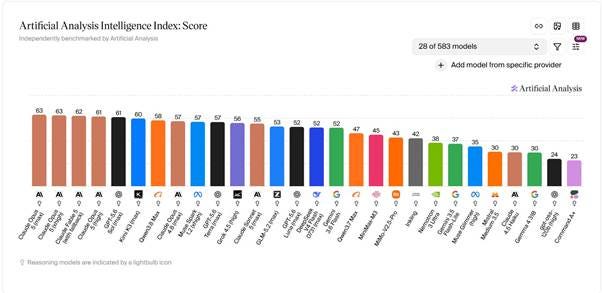
Google’s flagship Gemini 3.6 Flash ranks in the middle at 52. In this rest it I behind various Anthropic, OpenAI, Meta (Muse Spark), Grok and several Chinese models such as KimiK3, Qwen 3.8max, Z.ai’s GLM 5.2 and DeepSeek V4. It occupied a middling position in a crowded field.
Models were evaluated based on Token Usage, Cost, Speed etc. Some of the Chinese models perform very well on cost and Google models perform well on speed.
We should note that Gemini 3.6 flash despite some technical limitations, already as 1bn users. This is the testament to Google’s Gemini brand and the power of their distribution. This supports those who argue that the key to success is distribution and not having the most advanced model.
However, the Alphabet founders and senior management are probably quite unhappy with their progress. The Gemini 4 frontier model has been delayed.
Sundar Pichai put a brave face on the delay in the recent post-earnings conference call:
Gemini 3.5 Pro is currently in testing, and our team is already building the next generation of models. We have started our most ambitious pre-training run yet for Gemini 4 and are excited by the progress we are seeing at the frontier.
This unhappiness may be the reason for the change in senior management announced last week.
The noble prize winner, Demis Hassabis stepped back from day-to-day management of AI research. In addition, four top AI figures, including veteran engineer Jeff Dean, left Alphabet for their own AI start-up.
Alphabet stock fell 4% on the announcements.
As is well known, Hassabis had founded Deepmind and stayed on after it was taken over by Google and re-named Google Deepmind. He insisted on staying in London and resisted the pressure for him to move to Silicon Valley.
Hassabis had the title of CEO of Goggle Deepmind; his replacement, who is based in San Francisco, will be a senior vice-president, implying less autonomy in how the unit operates and closer alignment with other Google divisions.
Hassabis said he was stepping back to “focus on the big picture”, with a wider remit that includes becoming chief scientist of Alphabet.
The departure of Dean and three other top Google AI figures can be explained by the lure of startup. Discovery Loop aims to transform large areas of scientific research by automating the basic scientific process. Google will be a founding investor and cloud partner for Discovery Loop.
Dean joined Google 27 years ago (as employee number 30) and had watched it to 190k plus people. He and his colleagues, including Sanjay Ghemawat, had founded Google Brain in 2011 the pioneering deep-learning research organization in Google. He was also the driving force behind TPUs.
In a tribute, Pichai said Dean and Ghemawat “helped drive some of the most significant technology transitions” during their tenures, from early search infrastructure to the neural networks that shaped modern AI.”
The rationale behind Discovery Loop is a belief that AI system have advanced so fast they can automate the scientific research process by automatically proposing hypotheses, running experiments, and analysing results to speed up scientific breakthroughs.
Hassabis, has also said he would also be “leaning in” more to his work leading Isomorphic Labs, a drug discovery start-up he created inside Alphabet in 2021.
These trends reflect a change in the AI landscape. It may be AI winners will not be those who can produce the most advanced LLMs but those who design the best software “harnesses” that control how AI agents (which can now perform increasingly complex tasks) utilise the underlying frontier models. AI agents already do coding, scientific research and generic forms of white-collar work. The range and complexity of their work is likely to grow rapidly.
Hassabis is not leaving. He was first and foremost a scientist, more interested in winning Noble prizes than developing products which would generate huge revenues.
Dean and his teams has collectively spent over 100 years at Google and were understandably attracted by a compelling entrepreneurial opportunity.
The business of Frontier Models is highly capital intensive and very competitive. The leading model from six months ago can be rapidly superseded by the latest model today. The many Chinese models are very cost competitive.
Foundation models could become a commodity. For all but the most advanced tasks, users will not insist on a particular model but use the cheapest of the long list of “good enough” models.
The real value will be in the AI applications that will be built on top of the models.
Investors sold Alphabet on these changes thinking they indicated failure in the advanced LLM race. We believe that is misplaced.
The LLM “race” is long, and the eventual “winner” may not be known for some time, Alphabet could well prevail. However, the prize money of this race may not be very high. The more lucrative races may be in complex AI driven system applications, that will be enabled by LLMs. It is too early to say who will be the winners, but Alphabet has as good a chance as anybody of being among them.