Coreweave (and Nebius NV)
The Neoclouds – Riding the AI wave.

Yesterday, the share prices of Nebius Group NV and CoreWeave (CRWV) jumped by 33% and 19.7%.
These are big moves for companies with market capitalisation of $35bn and $49.2bn. Nvidia has a ~8% -10% equity stake in both,
We have been aware of these so-called Neoclouds for some time but have not had the chance to write about them.
We write a short note about Coreweave and much of it will probably apply to Nebius to some extent.
Introduction
CoreWeave, Inc. is a cloud infrastructure technology company. The company was founded in 2017 and in 2020 launched the CoreWeave Cloud Platform (CCP). This consists of software and cloud services that deliver the automation and efficiency needed to manage complex artificial intelligence (AI) infrastructure.
CCP is an integrated solution that is purpose-built for running AI workloads such as model training and inference.
Its solutions include
Infrastructure services (IS).
Managed software services (MSS).
Application software services. (ASS)
IS provides access to advanced GPUs, CPU server clusters, networking, and storage.
MSS include CKS, a flexible virtual private cloud and a bare metal service that runs Kubernetes directly on high-performance servers. Kubernetes is freely available infrastructure. It takes containers (packaged units if applications) and orchestrates them across a cluster of machines
ASS build on top of IS and MSS integrating additional tools.
They operate their platform across a distributed network of purpose-built datacentres interconnected through a proprietary global network backbone. At the end of 2023 they had 10 datacentres with ~70MW of power. Today they have 50 with 1.5GW and have plans to expand to 8GW by 2030.
Customers generally access their platform through multi-year committed contracts, under which they purchase a specified amount of capacity on a take-or-pay basis over the contract term.
CRWV are usually the first company to deploy new advanced chips and hardware at scale; most recently the NVIDIA GB200 and GB3000 NVL72 systems. They are a major customer of Nvidia GPUs, software and networking.
Financial Performance
CRWV is experiencing rapid, capital-intensive growth driven by the surging demand for AI infrastructure. Revenue reached $2.58bn for the most recent quarter a 112% increase (y/y).
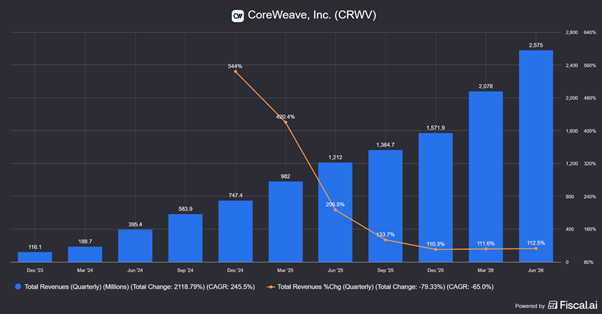
It was the seventh successive quarter of 100% plus growth. Revenue growth is very strong.
The company claims adjusted operating profit was $128mn with the adjusted margin expanding meaningfully. However, the unadjusted operating income was a loss of $49mn.
Under conventional accounting, growth has been accompanied by substantial losses.
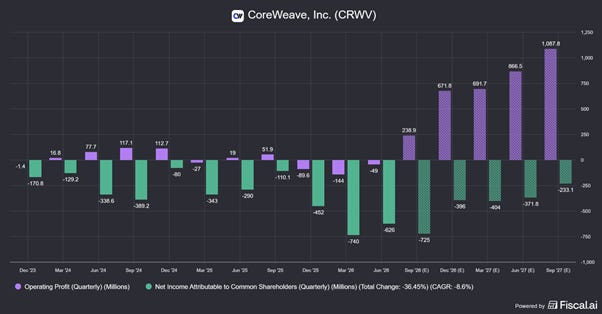
While the company is expected to make positive operating profit from the next quarter, it is expected to make losses at the net level through to at least 2027. The green bars in the chart above.
The reason for this divergence in mainly interest expense. The company is aggressively investing in its data center footprint and technology infrastructure. Net Property, Plant and Equipment has increased from $4bn to $63bn in three years
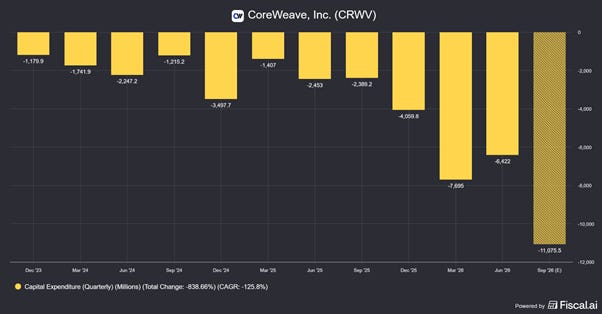
Capital expenditure has increased to $6bn to $7bn a quarter from $1bn.
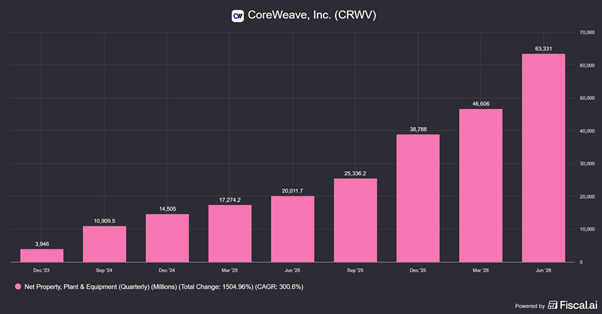
This capital expenditure has been funded by long-term debt and leases.
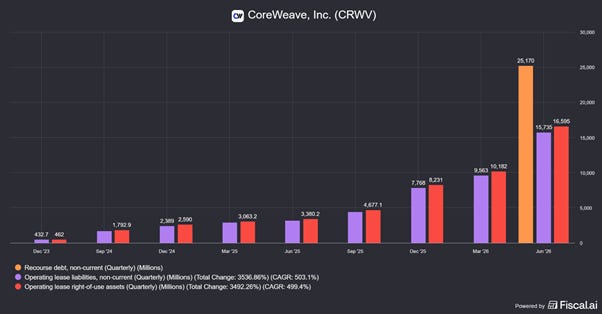
The increase in debt means interest expense has also increased
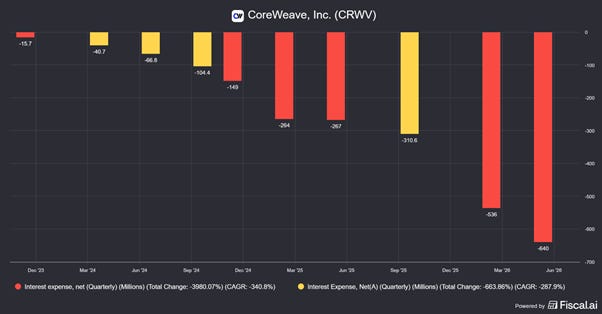
This is shown in the chart above as a negative bar as it represents a cash outflow. In the most recent quarter, interest expense was $640mn while operating income was minus $49mn. Financing costs are high and rising.
The business model relies heavily on long-term, committed take or pay contracts, which provide a degree of revenue visibility but require massive upfront capital expenditures, largely financed through debt and equity issuances as well as growing operating cash flow.
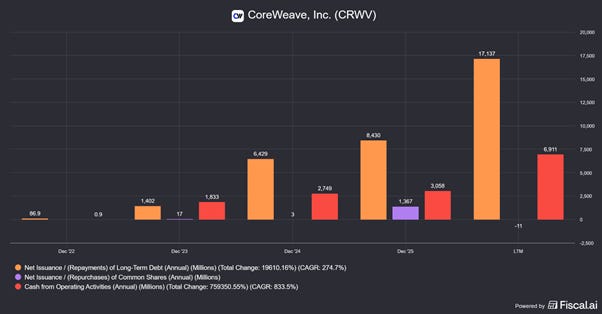
Other notable features of the numbers:
There is significant customer concentration. In H1 2026, two customers accounted for 40% and 23% of revenue, respectively. These are thought to be Microsoft and OpenAI.
There is a huge orderbook. At the end of H2, the company had $103.7bn in unsatisfied remaining performance obligations (RPO), with 41% expected to be recognized over the next 24 months.
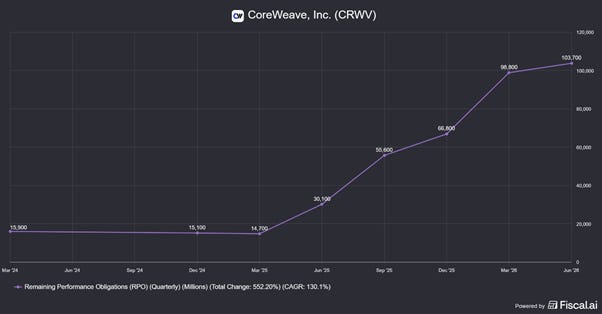
In contrast FY2025 revenue was just $5bn. This means they are set for explosive revenue growth and have good revenue visibility
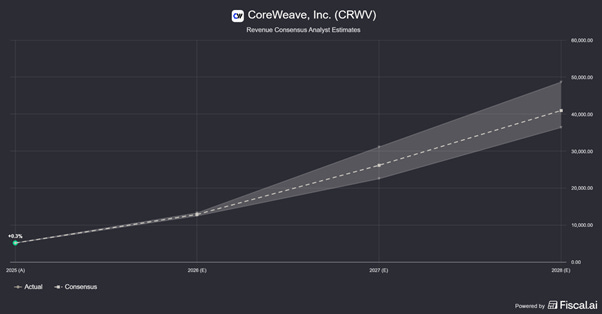
The consensus analysts’ estimates are they will have revenues of $440bn in FY 2028.
There will be further Infrastructure Expansion: The company has executed additional lease agreements for datacentres and equipment not yet commenced, with estimated future undiscounted lease payments totalling $35.5bn. The company will continue to borrow to invest. It will require benign and stable debt markets.
Strategic Outlook
CoreWeave’s strategy is to be critical infrastructure provider for the AI industry. The company is actively scaling its data center capacity through complex, capital-intensive projects, including joint ventures and direct development. While the company believes its current liquidity is sufficient to meet obligations for the next year, its long-term success is contingent upon its ability to manage rapid growth, navigate significant debt obligations, and successfully integrate new infrastructure and acquisitions.
The company is seeing very strong growth. In a relatively short time it has built an impressive technical capability and the ability to execute well at the frontiers of knowledge.
They have a wide range of customers: customers mentioned on the post earnings conference call include IBM, Caterpillar, Isomorphic Labs (part of Google Deepmind) and Grammarly
The company’s reliance on a small number of large customers and the inherent risks of the evolving AI market remain central factors in its forward-looking risk profile.
CoreWeave claims it has successfully rearchitected the cloud stack from a first-principles basis to address the specific demands of parallelised compute, which is the foundation of modern AI workloads. As I understand it, parallelised compute means many tasks can be executed at the same time in parallel.
They claim this is unlike hyperscalers that rely on serialized compute designed for redundancy. CoreWeave’s proprietary orchestration layer optimizes for high-performance GPU clusters, allowing for efficient provisioning,
The company claims this technical differentiation enables CRWV to serve as a trusted partner to the world’s most sophisticated AI labs, including OpenAI, Anthropic, Meta and Microsoft while simultaneously delivering a lower total cost of ownership (TCO) to customers despite charging a premium per GPU hour.
CRWV claims they are the only independent cloud provider capable of serving the entire ecosystem of AI leaders, from research labs to hyperscalers and enterprise customers.
The Q2 numbers just released seemed to be very bullish
Adjusted operating income came in at $128mn against a $30-$90mn guidance.
It was the second quarter that management beat their own margin expectations.
They claimed there has been an inflection point in margins (based on the adjusted data). This margin improvement was before their July price increases.
In Q2, the customer contracts we signed came with contribution margins we expect to be 5 Percentage points to 10 percentage points above those added in recent quarters.
Revenue backlog hit $104bn and another $25bn of commitments has already been added in Q3.
CoreWeave enters the second half of the year with more momentum than at any point in our history. AI is reshaping every industry. The pioneers that are building need more than compute, and that is why they come to CoreWeave for an AI cloud designed for the full AI life cycle, serving any workload from frontier training to rapidly scaling inference.
Summary
This is a company raising and borrowing a lot of money and making huge capital investments. Revenues are growing but operating profits cannot yet cover the interest expense alone.
Positive earrings and positive free cash flows are way ahead in the future. The general rule is the farther they are in time, the more uncertain they are.
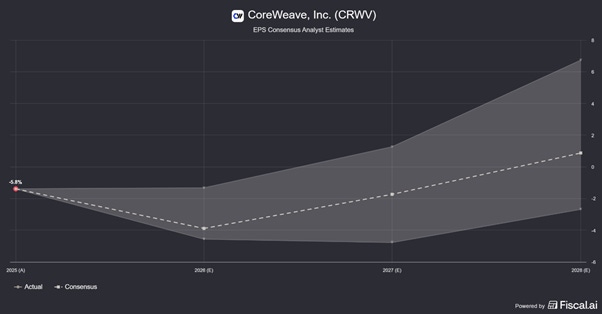
The consensus analysts estimates sees the first positive eps in FY 28 at 88 cents. The current share price is $110 which means the two-year forward P/E ratio is 125X. The valuation only makes sense if you assume a lot of growth
Given the heavy capex the company is expected to be negative free cash flow for the next two years.
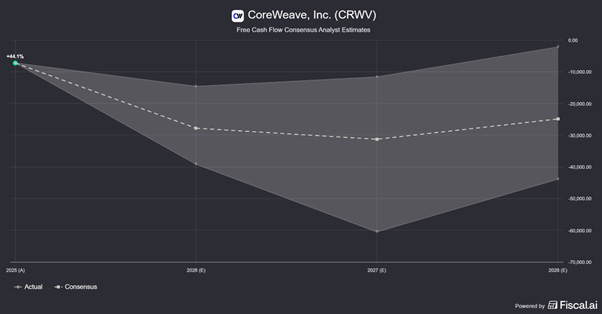
The consensus analysts estimate is that free cash flow will be minus 24bn in FY28. Therefor we cannot value it based on free cash flow multiples.
As a minority fundamental investor, we do not like such companies. Since there are no earnings or free cash flows, it is very difficult to value them.
One of the key issues is the residual value of the GPUs that CRWV owns. The accountants many have assumed an economic life of say five years so old chips would now be fully depreciated and written down to zero. However, they claim even six years old chips such as the Nvidia Ampere 100 are earning attractive revenues.
As an example, we recently signed an A100 (Nvidia Ampere 100) contract that extends into 2029 at an attractive price. As a reminder, this SKU was introduced in 2020.
If this is true, GPUS and the rack of servers housing them many have a longer useful life than their accounting treatment suggests. Jensen Huang gave a similar comment recently on his article this week. He was arguing that with much longer earing life, GPUs and CPU were like long dates infrastructure assets and such would be funded by third parties.
Conclusions
An investment in the stock of Coreweave may or may not make money in the long run. However, investing in CRWV is too much of a gamble for our risk tolerance. There are other less risky ways of playing the AI investment theses such as the large hyperscalers, Nvidia and TSMC.
However, CoreWeave and Nebius NV are very interesting companies, and we will continue to try and follow them closely.