SaaS Apocalypse

‘We took a couple of weeks off to travel to Costa Rica. It is a beautiful country which seems to be on a path of Sustainable development. While we were away, we did not look too much at the news.
Coming back and reviewing the markets, everything seems to have changed. That is an exaggeration, but perhaps not a complete one.
The share prices of many software companies have collapsed. The iShares Expanded Tech-Software Sector ETF (IGV) has fallen 21.7% this year already and we are only in mid-February. Over the same period, the S&P 500 index is only down 1.2%. According to some reports the value destruction has been about one trillion dollars.
In general, investors seem to be switching out of technology into sectors such metals, materials, real estate and consumer discretionary.
What is going on?
My search for an answer started by reading a blog post by Matt Shumer which was titled “Something Big Is Happening.” You can find it here.
Schumer argues the speed of the development in AI is accelerating faster than sot people realise.
For years, AI had been improving steadily. Big jumps here and there, but each big jump was spaced out enough that you could absorb them as they came. Then in 2025, new techniques for building these models unlocked a much faster pace of progress. And then it got even faster. And then faster again. Each new model wasn’t just better than the last... it was better by a wider margin, and the time between new model releases was shorter.
About a year ago Open AI and Anthropic delivered some tools which could write code. It was argued, people without technical coding skills could describe (in natural language) what they wanted to build and the model would take a stab at it. This approach was described as vibe coding. The result often was a good first effort. A human developer or coder would still be needed to refine the code, remove errors and test the overall output thoroughly. Thus it was thought, AI was a tool to which help human coders and developers become much more productive.
However, according to Schumer, there was major change on February 5th 2026.
Then, on February 5th, two major AI labs released new models on the same day: GPT-5.3 Codex from OpenAI, and Opus 4.6 from Anthropic (the makers of Claude, one of the main competitors to ChatGPT).
A single training run, managed by a small team over a few months, can produce an AI system that shifts the entire trajectory of the technology.
He thinks his work, as a software developer, can be now done entirely and perfectly by AI.
I am no longer needed for the actual technical work of my job. I describe what I want built, in plain English, and it just... appears. Not a rough draft I need to fix. The finished thing. I tell the AI what I want, walk away from my computer for four hours, and come back to find the work done. Done well, done better than I would have done it myself, with no corrections needed. A couple of months ago, I was going back and forth with the AI, guiding it, making edits. Now I just describe the outcome and leave.
The AI does the work.
If it doesn’t like how something looks or feels, it goes back and changes it, on its own. It iterates, like a developer would, fixing and refining until it’s satisfied. Only once it has decided the app meets its own standards does it come back to me and say: “It’s ready for you to test.” And when I test it, it’s usually perfect. I’m not exaggerating. That is what my Monday looked like this week.
Schumer say this experience will be faced by developers will many other knowledge workers.
The experience that tech workers have had over the past year, of watching AI go from “helpful tool” to “does my job better than I do”, is the experience everyone else is about to have. Law, finance, medicine, accounting, consulting, writing, design, analysis, customer service. Not in ten years. The people building these systems say one to five years.
AI isn’t replacing one specific skill. It’s a general substitute for cognitive work. AI doesn’t leave a convenient gap to move into. Whatever you retrain for, it’s improving at that too.
If your job happens on a screen (if the core of what you do is reading, writing, analyzing, deciding, communicating through a keyboard) then AI is coming for significant parts of it. The timeline isn’t “someday.” It’s already started.
Eventually, robots will handle physical work too. They’re not quite there yet. But “not quite there yet” in AI terms has a way of becoming “here” faster than anyone expects.
After two days this paper was viewed 100mn times. Why was it so popular?
In a sense, the quality or accuracy of the paper does not matter: 100mn people read it and were influenced by it. Some them were investors or analysts working for investors and they pressed the sell button afterwards.
Why was it such a hit? In part, it was because some famous people recommended it. In part, it was because it extended or developed an existing narrative. There has been a lot of discussion about the impact of AI on jobs . They assumed it was 5-10 year in the future. Schumer argues it is happening now.
If AI is going to make knowledge workers much more productive, companies will need fewer of them. If they have fewer workers, companies will buy less software.
The software in question includes well known products such as Adobe Acrobat, Salesforce CRM, Microsoft Office, Slack as well as analytical software supplied by FactSet, Reuters or RELX and so on. These companies are known as Software as a Service or SaaS companies.
Some SaaS serves a particular market. These are known as Vertical Market Software (VMS). For example, FactSet and Reuters’ Financial Analysis software is targeted at people working for large financial institutions, dealing in traded assets. RELX’s Lexis Nexis database is aimed at lawyers. Other software is general. E.g. Microsoft Office or Adobe Acrobat are found everywhere.
SaaS companies have converged to a per seat revenue model. Their modus operandi is to sell highly-priced, individual user licences every year. As the number of knowledge workers grew in the last two or three decades, SaaS companies saw their revenues grow strongly.
SaaS companies have stable and or growing revenues and high gross margins. For established software products, the marginal cost of selling new licences is low.
In the last year or so, the market has been worried about the AI threat to Saas business model. SaaS stocks underperformed the market. In 2026, their declines accelerated. The iShares Expanded Tech-Software Sector ETF is down 24% in the last six months and 21% YTD in 2026.
Many shares which were trading at P/Es of 25X are now at P/Es of 10X and 12X. This illustrates the importance of buying at the right price and not overpaying. Valuations matter.
Analysts and commentators have started producing and circulating lists of stocks which are at risk in the Saas apocalypse. An example is given below. We should say we have not looked at all the companies in the list below or the criteria for inclusion.
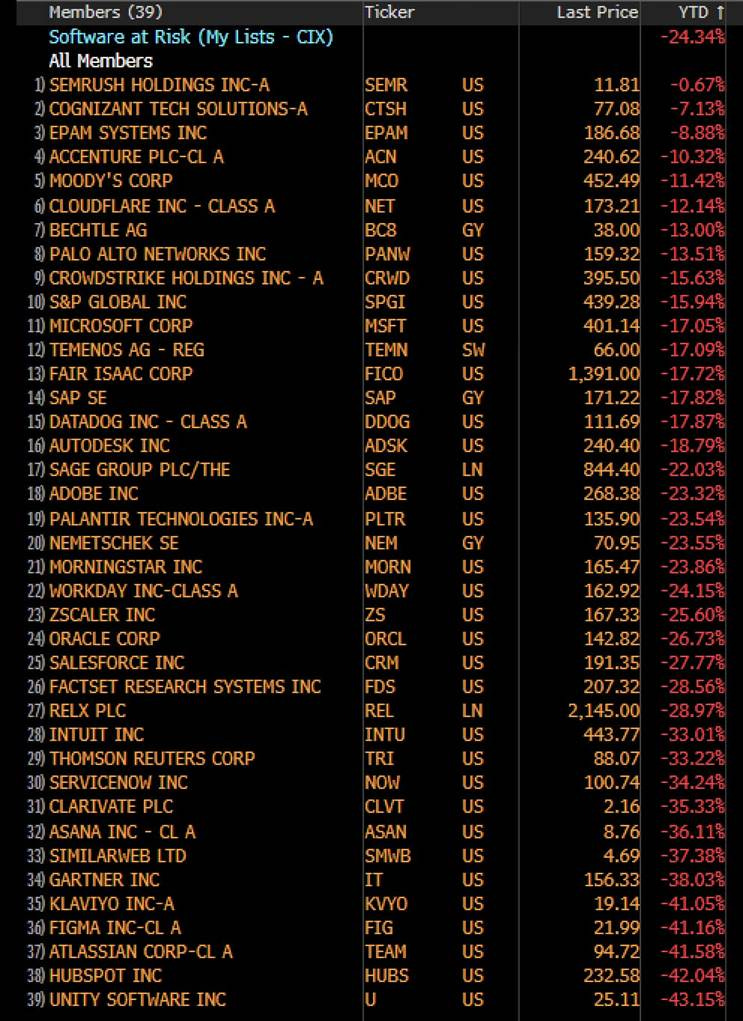
We have only committed significant capital to one of the above stocks which is Microsoft.
There has been substantial decline in the sector and many investors are sitting on huge loses in their portfoliolos. This often happens. Markets often go from euphoria to pessimism. Our only job is to the look at the prices being offered by Mr Market and to determine conservative fair valuations to see whether there are any huge discounts in the wreckage,
A few days after the Schumer essay there was another, written by David Oks. This was titled
“Why I’m not worried about AI job loss” and it can be found here.
Oks argument is
“the actual impacts of AI in the real world will be a lot slower and more uneven than people like Shumer seem to think. Human labor is not going away anytime soon. And whether or not they spend an hour a day using AI tools, ordinary people will be fine.”
AI can have an absolute advantage in every single task, but it would still make economic sense to combine AI with humans if the aggregate output is greater: that is to say, if humans have a comparative advantage in any step of the production process.
Even in a domain like software engineering where the extent of AI capabilities is on full display, that the human-AI combination, the “cyborg,” is superior to AI alone—not least because you still need to tell the coding agent your preferences, or your company’s preferences, or your customer’s preferences.
Oks may well be right. Whenever major new technologies emerge, market almost always overestimate the short-term impact of the technology but underestimate the impact in the long-run.
However, in the short term, the Schumer narrative has had a huge impact. SaaS stocks are trading at significantly lower valuations than they have in recent years. This seems to be good place to look for one or two good bargains.
SaaS Moats
Saas companies had such high valuation was due to their perceived moat.
Consider Bloomberg. It is not a quoted company but it will provide a good example. They sell a well-known financial terminal that includes vast amounts of data, analytic tools of all kinds, news services and a message that allows you to communicate instantly with any other users. It is used by traders and fund managers across the world. Their workflows are embedded in them so back office and middle staff who process and settle the trades also need access to Bloomberg Terminals.
Bloomberg have one product and one price with virtually no discount at all. The cost is about $ 25,000 per user. Bloomberg currently has over 350,000 subscribers. The revenue of one of the largest software companies in the world can be accurately estimated as number of users times the terminal cost (325,000 times $25,000) or about $9bn.
In general, if the individuals continue to work, the Bloomberg licences are renewed. The workflows and work processes rely heavily on the Bloomberg terminal. The Bloomberg has become the de facto industry standard as its deeply embedded in industry processes and protocols.
The source of the Bloomberg moat is the switching cost. If they switch systems, staff have to be trained, work processes have to be redesigned and new communications channels established. For a financial institution it would be impossible to switch away from Bloomberg if all their counterparties remain on the system.
Bloomberg is a good example of a Vertical Market Software (VMS). Other VMS includes FactSet (which partially competes with Bloomberg), Veeva in Life Sciences industry, LexisNexis (owned by RELX) in the legal industry, Adobe Photoshop in the creative industry, Autodesk in Design and Engineering and so on.
Microsoft Office is a general software which has done well despite keen competition form Google and others. Once users are trained on using it, it makes little sense to switch as workers will need to be retrained. Many job applications demand Office skill as a pre-requisite.
Have these moats been destroyed by the rise of Large Language Models (LLMs) and the very rapid in advances in AI described by Schumer above? Judging by the declines in share prices and valuations, the market believes they have.
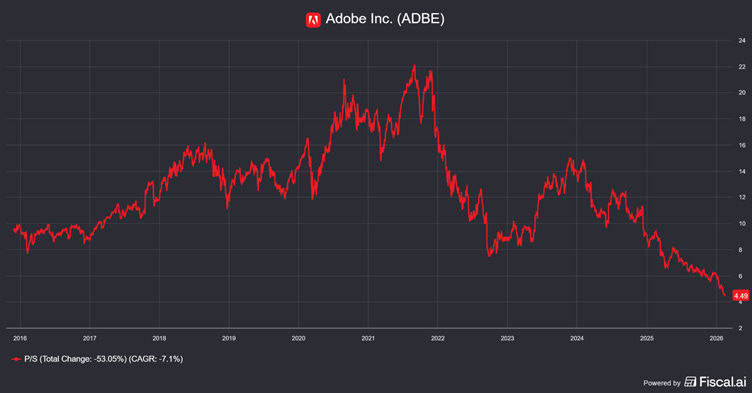
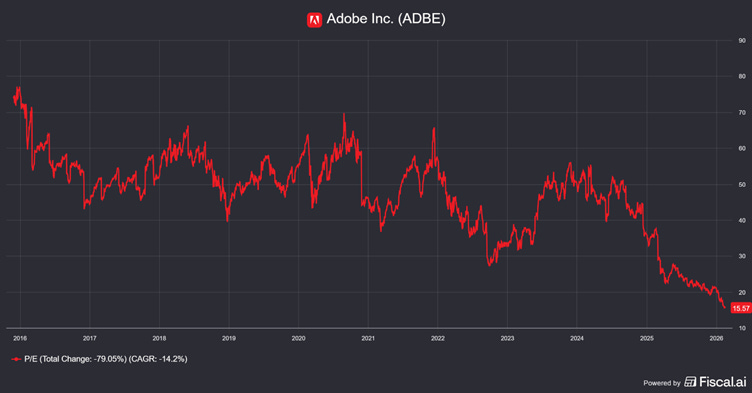
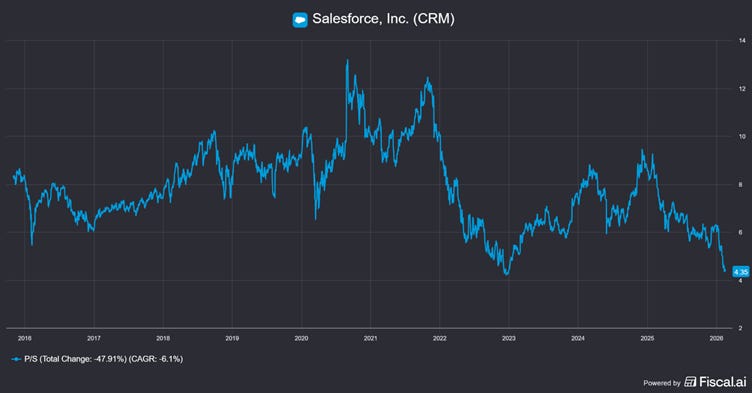
For example, the Price to Earnings (P/E) Ratios and Price to Sales Ratio (P/S) have fallen so much as to suggest Adobe has a weak moat. Similar trends can be seen in Workday and Salesforce below.
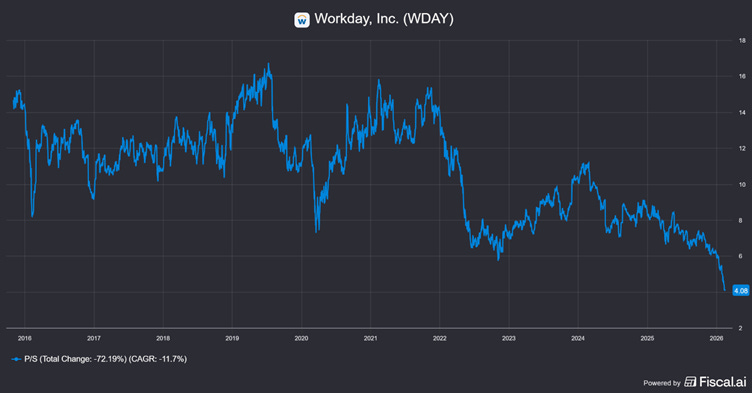
SaaS company revenues are driven by the number of users. AI may make workers productive so fewer will be needed. In many cases, AI agents will talk to each other and the software and humans will be removed from a part of the work process altogether. In either case, the number of users could decline quite significantly and therefore SaaS revenues will collapse.
However, the market could be wrong about the extent and speed with which revenue will disappear and gross margins will compress.
If the SaaS busines model falters, companies will lose pricing power and this will be seen in the decline of revenue growth and gross margins,
If gross margins fall from the 75% to 85% currently to say 50% to 60%, companies will have to reduce operating expenses significantly especially in sales and marketing.
However, not all companies will be equally affected. Some companies will be able to resist the collapse in revenues and the compression in margins. For example, the network effect is very strong. In the Bloomberg Terminal, the chat function is key. If you are a trader or a fund manager, you have to be on Bloomberg as all your actual and potential counterparties and peers are there nad you need to be able to chat with them.
The situation is fast moving and the technologies involved are way too complicated for a non-technical specialist for myself to understand. The fact is technologies change all the time, markets respond and valuations of securities change greatly.
All we can do is what we have always done. We will look for promising business with good prospects run by competent people with integrity.
We have to try and identify those companies whose moats are likely to have some meaningful protection to the impact of AI.
We will then try and value the companies’ securities using conservative assumptions and see if the securities are trading in the market at prices which are at a discount to the computed fair value. It is going to be interesting.
The moat question at the end is the right one, and I think it deserves a slightly different frame than the traditional switching-cost analysis.
Carlota Perez's work on technological revolutions suggests that what we're watching in SaaS isn't moat destruction so much as value migration. Every major revolution has a moment where the business models optimized for the installation phase become structurally misaligned with the deployment phase. Per-seat SaaS licensing is an installation-era business model: it assumes the end user is a human who needs a tool. If AI shifts the work from humans using software to agents operating through software, the moat isn't switching cost anymore. It's whether you control the data layer, the workflow logic, or the integration surface that agents need to pass through.
Bloomberg is actually a perfect example of what a deployment-resilient moat looks like. The terminal's value isn't really the analytics (AI can replicate that). It's the network: the counterparty graph, the chat protocol, the fact that the entire industry's communication infrastructure runs through it. That's a moat that gets stronger as AI agents need to interact with the same counterparties humans do.
The companies trading at 10-12x earnings deserve a harder question than "is this cheap enough?" The question is whether their moat is built on human user dependency or on something structural that persists regardless of who, or what, is doing the work.