Amazon (AMZN)
Annual Letter from Amazon CEO

Annual Letter from Amazon CEO
We have written about Amazon in the past. The first was an “Initiating Coverage” type note on 12 May 2023 and can be found here.
The most recent report can be found here.
Andy Jassy has continued founder Jeff Bezos’s tradition of writing an annual CEO letter. The most recent such letter has just been published. It usually contains interesting insights.
Jassy begins by noting that we are in a period of unprecedented change.
We’re in the middle of some of the biggest inflections of our lifetime (e.g. AI, robotics, space industrialization, geopolitical and military conflict).
The first of this, AI, is the big opportunity Amazon is betting on.
We have never seen a technology more quickly adopted than AI. When ChatGPT launched in November 2022, it reached 100 million users in two months—four times faster than TikTok and 15 times faster than Instagram (ChatGPT already has over 900 million weekly active users). Both OpenAI and Anthropic have revenue run rates reportedly approaching $30 billion.
Amazon is well positioned for this as they have Amazon Web Services (AWS).
Amazon is smack in the middle of this land rush, and companies are choosing AWS for AI. Three years after AWS launched commercially, it had a $58 million revenue run rate. Three years into this AI wave, AWS’s AI revenue run rate is over $15 billion in Q1 2026 (nearly 260 times larger than AWS at that same point)—and ascending rapidly.
AWS growth has come despite binding capacity constraints.
In Q4 2025, AWS reported 24% YoY growth with a $142 billion dollar revenue run rate. That’s a lot of absolute growth. And yet, we still have capacity constraints that yield unserved demand.
Amazon believes that it is creating a big business producing chips for AI workloads.
Virtually all AI thus far has been done on NVIDIA chips, but a new shift has started. We have a strong partnership with NVIDIA, will always have customers who choose to run NVIDIA, and we will continue to make AWS the best place to run NVIDIA. However, customers want better price-performance.
Our second version of our custom AI silicon (Trainium2) had about 30% better price-performance than comparable GPUs, and has largely sold out. Trainium3, which just started shipping at the start of 2026 and is 30-40% more price-performant than Trainium2, is nearly fully-subscribed. A significant chunk of Trainium4, which is still about 18 months from broad availability, has already been reserved
Amazon Bedrock, AWS’s primary (and very fast-growing) inference service, runs most of its inference on Trainium. Demand for Trainium is booming.
If our chips business was a stand-alone business, and sold chips produced this year to AWS and other third parties (as other leading chips companies do), our annual run rate would be ~$50 billion.
The AWS AI build up will require he up-front investments, but the pay off will be long-lived.
The way AWS’s cash cycle works is that the faster AWS grows, the more short-term capex we’ll spend. AWS has to lay out cash for land, power, buildings, chips, servers, and networking gear in advance of when we can monetize it (typically 6-24 months before we start billing customers, depending on the component). However, these capex investments fund assets with many-year useful lives (30+ years for datacentres; 5-6 years for chips, servers, and networking gear).
This will mean an initial dip in Free Cash Flow (FCF)
The FCF and ROIC for these investments are cumulatively quite attractive a couple years after being in service; however, in times of very high growth (like now), where the capex growth meaningfully outpaces the revenue growth, the early-years FCF is challenged until these initial tranches of capacity are being monetized and revenue growth out-paces capex growth. We’ve been through this cycle with the first big AWS growth wave, and liked the results. We expect to feel similarly about this next wave, with much larger potential downstream revenue and FCF.
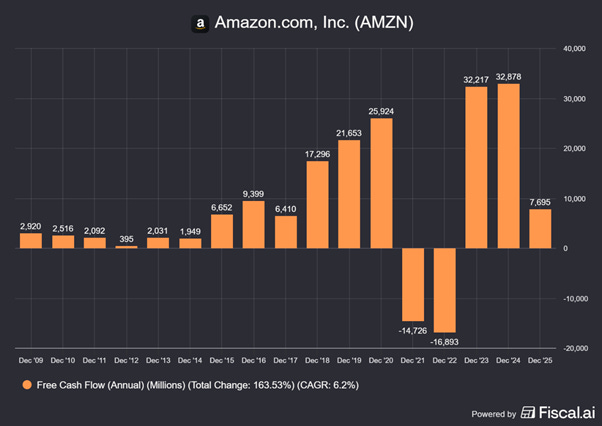
Amazon Free Cash Flow has often dipped when company has made aggressive investment bets
The payoff form these investments are large and predictable as customers are lining up
We have customer commitments that make our capex investments predictable. We’re not investing approximately $200 billion in capex in 2026 on a hunch. The recent OpenAI commitment (over $100 billion) is an example of this, but there are several other customer agreements completed (and unannounced), or deep in process. Of the AWS capex we expect to spend in 2026, much of which will be monetized in 2027-2028, we already have customer commitments for a substantial portion of it.
One of the remarkable things about Amazon is how they have always sacrificed short- and medium-term cash flow by investing for larger eventual long-term returns. This is not about to change.
We are willing to make large capex investments and endure short-term FCF headwinds for the substantial medium to long-term FCF surplus. AI is a once-in-a-lifetime opportunity where the current growth is unprecedented and the future growth even bigger.
We’re not going to be conservative in how we play this—we’re investing to be the meaningful leader, and our future business, operating income, and FCF will be much larger because of it.
Robotics
We now have over one million robots operating in fulfillment centers helping with stowing, picking, sorting, and intra-facility transport.
Low earth orbit satellite network
Over the last seven years, we’ve built a low Earth orbit satellite network (Amazon Leo) and put more than 200 satellites into space (which is the third-largest low Earth orbit network operating today). With a few thousand more satellites launching in the coming years, the constellation is expanding rapidly.
While Amazon Leo is officially scheduled to launch in mid-2026, we already have meaningful revenue commitments from enterprises and governments.
Summary
It’s hard to overstate my optimism for what’s ahead.
Our retail business is now approaching $600 billion in top line, yet roughly 80% of global retail sales still happens in physical stores. That will change.
AWS is at a $142 billion revenue run rate, and yet 85% of global IT spend remains on-premises. This will change.
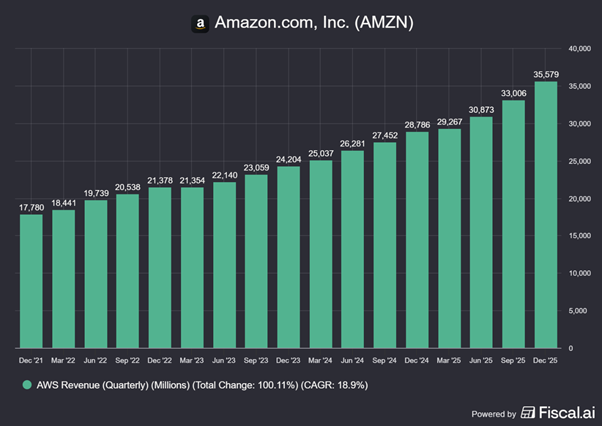
AWS Quarterly Revenue
Advertising has become a third major business albeit far behind Retail and AWS.
Our Advertising offerings continue to grow and deliver strong returns for brands, while newer businesses like Prime Video, Pharmacy, and Grocery are providing unique customer experiences, growing robustly, and improving their economics.
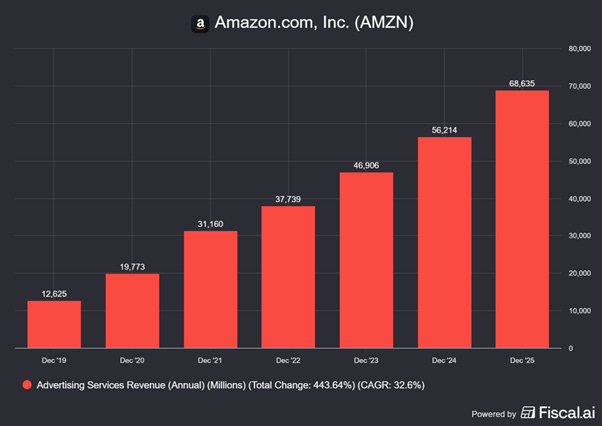
Advertising Revenue ARR is $70bn!
Conclusion
Amazon sees huge opportunities ahead and is investing aggressively to capitalise on these. While short-term cash flows may dip signficantly, they are confident of much larger cash returns in the long run.